
Dear Fellow VC Investor,
Last summer, I argued that while VC dollars were flooding into AI platforms, most venture firms were pursuing their own AI adoption down the wrong path. I also shared a framework, grounded in Ensemble’s experience, for how firms can and must unlock the value of AI through organizational change, not just tooling. Given the dealmaking activity in AI at that point (August 2025), VCs evidently had gained conviction in generative AI technology at enterprise scale.
Since then, private capital markets have reinforced that investors believe AI platforms will deliver value to unprecedented heights. AI deals made up 65% of all venture activity in 2025.1 Multi-billion-dollar rounds for LLM developers have become routine. LP capital is increasingly concentrated where it can access the most exclusive AI deals; megafunds ($500M) now hold nearly 60% of dry powder, up from just 40% a decade ago.
This comes as BCG reports that just 5% of companies are realizing substantial value from their AI investments, while 60% remain behind in building critical capabilities.2 McKinsey shows a similar pattern: of the 88% of companies using AI, just 7% report fully scaled programs.3
The Elephant in the Room
Judging by the way most VCs are deploying LP capital into AI investments, you’d have to think they’re super-users of the technology. Surely they’re constantly testing the latest range of tools, “vibe-coding” their own diligence software, and cutting out human biases through data. Unless they’ve seen what all the hype is about, how else could they justify such aggressive valuations?
The truth is that genuine AI adoption within venture firms remains rare. At a glance, many firms display cosmetic uses of AI, but not the kind of genuine, integrated adoption you’d expect from those deploying billions into AI-native companies.
As a data scientist turned venture capitalist, I find this baffling. This technology is obviously extraordinary, not just in its long-term promise, but in the clear and immediate advantages it offers to firms willing to rethink how they work. In every other aspect of our roles, early recognition of technologies and trends directly translates into better prices, higher returns on capital, and greater influence over outcomes. Founders and LPs deserve investors who actually understand the value of the tools they’re building and who are willing to use the best available tool to streamline innovation.
Explaining VC’s Lack of AI Adoption:
Misalignment, Misunderstanding, or Momentum?
So let’s revisit my first attempt to map out what it takes to build an AI-native VC fund. I created a framework based on Ensemble’s years of experience that offers an operational/behavioral roadmap to overcome what I saw the central roadblock: Firms underestimate behavioral changes required for AI adoption.
As you can see in the image below, I identify four levels of adoption marked by qualitative checkpoints.
The idea here is to emphasize that this requires a "big jump" ;an incremental approach (attempting to augment rather than replace a legacy firm structure) will fail at great expense.
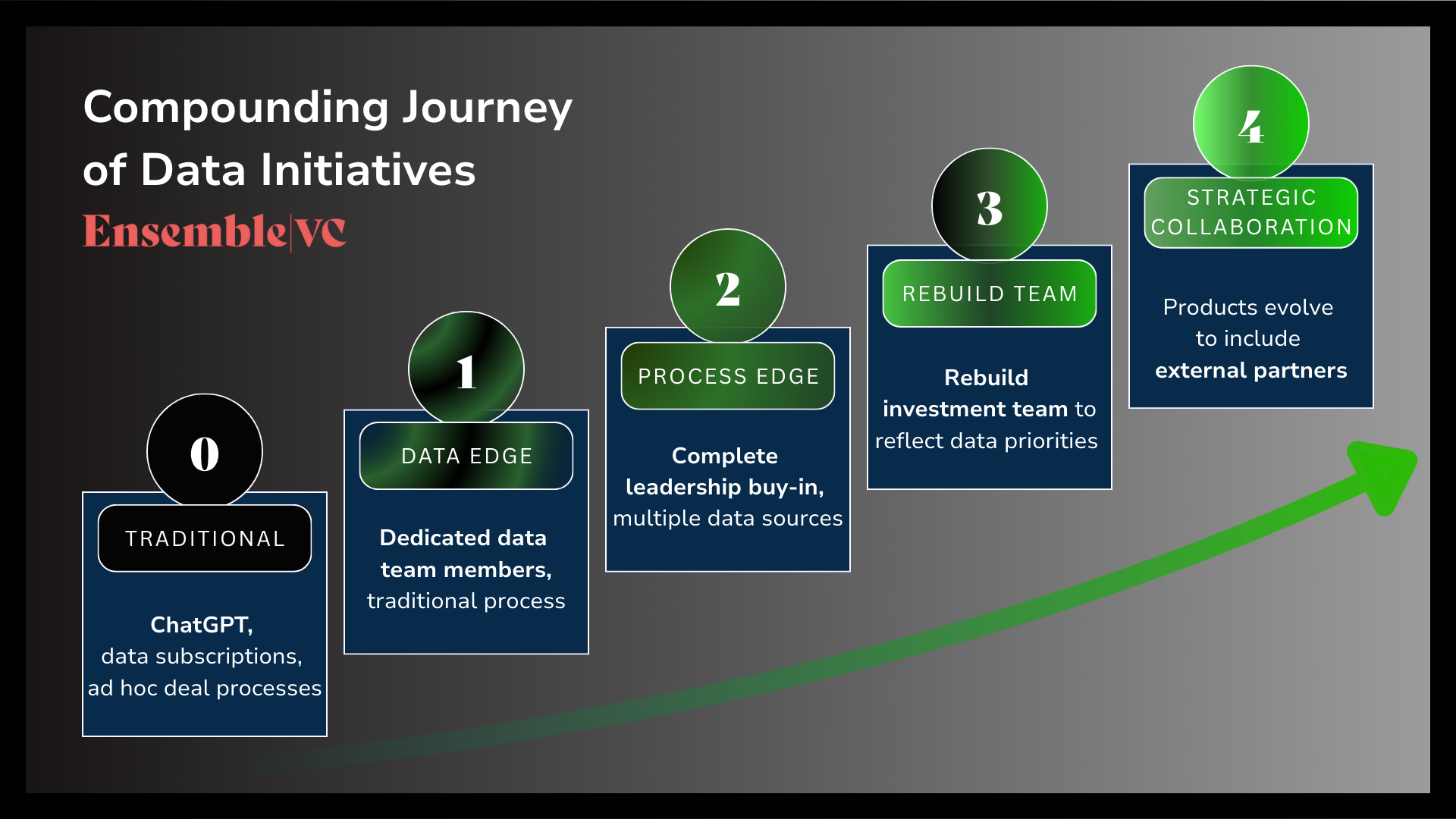
Why the costly failure? My thesis at the time was that most VC firms would go for an incremental approach to adoption. This is a trap - especially between Level 0 - 1 (adding data team members) and even more from Level 1 - 2 (getting complete buy-in from partners). Most firms simply aren’t designed to incorporate computational systems into their day-to-day processes, and their partners wouldn’t be willing to endure the cultural overhaul all at once.
Roadblock #2: No Shared Plan for “AI Adoption”
I see now that my original map was misguided. At the time, I emphasized behavioral adjustments because it’s the part most firms ignore. But behavior change only sticks when it’s tied to a concrete end-state: a clear definition of what an AI-native investment process actually looks like.
So let’s talk about the destination. When we talk about behavioral change, what is the practical organizational goal that this behavior should unlock? Let’s consider five stages of the investment process, and decide where AI can help.

How much time should a VC be spending on each of these phases, and how much can AI help us move toward that optimal?
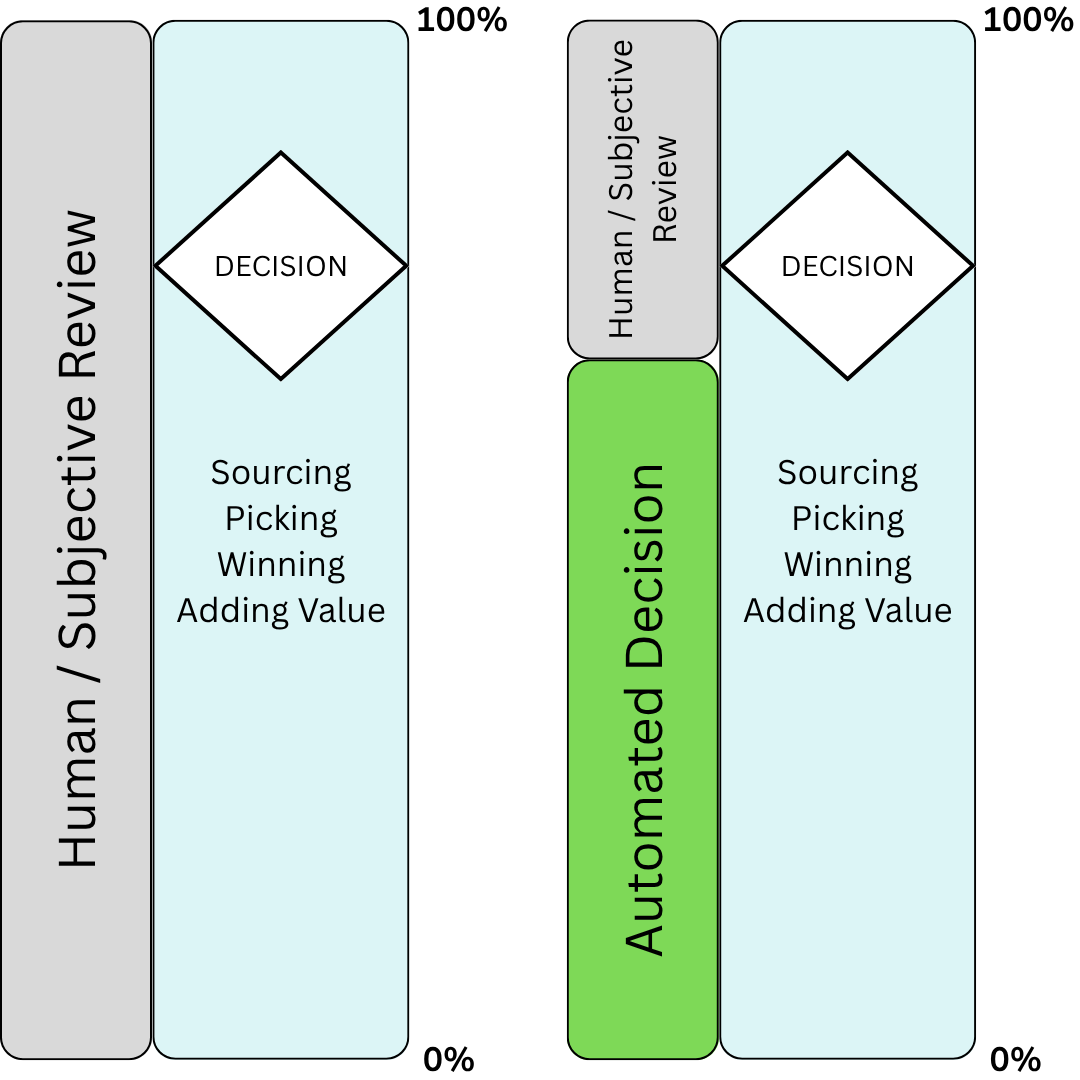
Let’s examine an illustration of a traditional process in terms of time spent, compared against Ensemble’s ideal framework.

The image shows an advantageous reorganization of team members’ time and energy. VCs spend too much time on low-level, reactive decisions, even though computers could handle these tasks much more efficiently. This excessive time commitment leads to highly siloed operations within firms. The fundamental reason past tools have failed to streamline VC operations is that the industry's crucial data is unstructured, and until now, the only effective way to interact with and synthesize that data has been human analysis.
That’s not the case anymore. AI enables firms to democratize the flow of unstructured information internally, so that other team members can continuously contribute to decision-making.
More concretely:
- The goal is fewer decisions, not more information. A computational workflow should materially reduce the number of marginal “should we look at this?” decisions, so the team can reallocate attention toward higher-value calls later in the funnel (validation, diligence, and ultimately the investment decision).
- AI converts the top of funnel from subjective to unbiased. By continuously monitoring companies and surfacing changes in real time, AI can make many low-value decisions (enrichment, de-duplication, basic qualification) that are currently handled inconsistently by humans, reducing noise and improving speed and objectivity in discovery and prioritization.
- An operational shift moves teams from reactive to proactive. The ability to act on all unstructured data is paramount to achieving this. It empowers teams with predictive capabilities, enabling them to prioritize efforts with the greatest impact. Everything runs more smoothly, there are fewer crazy last-minute panics, the workday is steadier, and the impact on what the firm truly cares about is greater.
- Workflow consistency creates compounding feedback. When discovery, prioritization, and validation are executed through a shared system, decisions become repeatable and measurable. The firm can then learn from its own behavior (which signals correlated with wins and losses, where bias crept in, and which heuristics are actually predictive) and continuously refine the operating model.
- A shared source of truth enables strategic collaboration. Once the firm’s context lives in a legible system (rather than scattered across inboxes, meetings, and private spreadsheets), more of the team can contribute at the right moments, and coordination with external stakeholders becomes meaningfully easier. This is the foundation for “strategic collaboration” rather than isolated partner-driven execution.
Roadblock #3: Partners Resist Democratization
I’ve read enough articles where VCs describe taking an early bet on a little-known founder who went on to build a generational company (and the role that particular VC played in that particular journey). I am surprised to see that same enthusiasm so rarely applied to building their own platform internally.
But this should actually come as no surprise if we revisit the “re-allocation of time” graphic. Notice that the high-level decisions in the latter half of the process (the ones that affect the direction of the firm) are the ones being “democratized.” Our framework is built to provide unbiased information to multiple stakeholders so that previously fragile decisions made by one partner become robust, well-informed, and well-measured consensus.
Accordingly, in most partnerships, leadership isn’t incentivized to treat data and engineering as anything but side projects. They are useful and sometimes impressive, but fundamentally peripheral to the firm’s operating model. The data team is asked to produce tools, not to define workflows. As a result, “AI adoption” often collapses into a handful of ad hoc utilities that are inconsistently used, loosely maintained, and structurally incapable of changing how the firm makes decisions. A half-hearted approach precludes any chance of real, lasting ROI.
Lack of trust manifests in firmwide frustration.
Earlier, I mentioned that Levels 1 (hiring dedicated data talent) and 2 (complete leadership buy-in) represent a persistent plateau.
Now we see why:
- At the outset, the partnership underestimates how much they need to disregard precedent, understaffing and underfunding the architects of AI-driven decision-making (the data team).
- They then interpret the lack of immediate transformation as evidence that “the data thing doesn’t work. We see this in BCG report, where ~95% of companies reporting “AI usage” haven’t achieved meaningful ROI.
This is while the data team gradually burns out under an impossible mandate: deliver compounding organizational change without the authority, buy-in, or behavioral shifts required for lasting progress.
Conclusion
I am deeply committed to this work because I have seen, firsthand, what it means to operate as a truly AI-native, data-driven venture firm. In this paradigm, advantage no longer comes primarily from individual heroics or idiosyncratic intuition, but from collective intelligence that compounds over time. The firm itself—not any single partner—becomes the learning organism. For some, surrendering unilateral control to systems that surface better, faster, and more objective judgment is uncomfortable. If that surrender feels untenable, however, the implication is clear: a new generation of investors will ultimately succeed those who cannot adapt.
I will close with the least understood aspect of AI adoption: the end state is not simply a handful of firms using better tools, but an industry reoriented around clarity, speed, and accountability. In such a world, fundraising will cease to be the arbitrary matching problem it is today. Founders will get resources, talent, and expertise more quickly, allowing them to deliver value to customers and investors at a greatly reduced cycle time. And that's what our business has always been about.
If you're working or investing in this field, we'd love to chat.
______________________
This is the second installment in Gopi's series on AI adoption within VC firms. Read the first piece here.
Citations:
- Stanford, K. (2025, December 23). AI, Megadeals, and the Making of a Concentrated Venture Market. PitchBook, a Morningstar company. Retrieved from PitchBook Institutional Research Group.
- Boston Consulting Group (BCG). (2025, September). The Widening AI Value Gap: Build for the Future 2025.
- McKinsey & Company, QuantumBlack AI. The State of AI in 2025: Agents, Innovation, and Transformation. Global survey of enterprise AI adoption, November 2025.
Neion Bio: Turning Farms into Medicine Factories
Learn how Neion Bio genetically engineers chickens to produce therapeutic proteins in their eggs, turning farms into biologics factories that run on grain and water.
WSJ: Saronic Corsair locates and rescues downed U.S. pilots
The Journal reports the crew had spent two hours in the water off the coast of Oman. An unmanned vessel (Saronic Corsair) found them and brought them to shore safely.
Critical Infrastructure is the Foundation of the New AI Economy
AI can only go as far as the underlying physical infrastructure allows.
Q2 Update: Ensemble VC’s AGM features world-leading founders, Ensemble data breakthroughs
Ensemble's 2026 AGM brought together founders, LPs, and investors for a deep dive into the interplay between AI and the critical infrastructure it's built on.