The Loop is the Moat
What we look for in physical AI companies
By Ian Heinrich
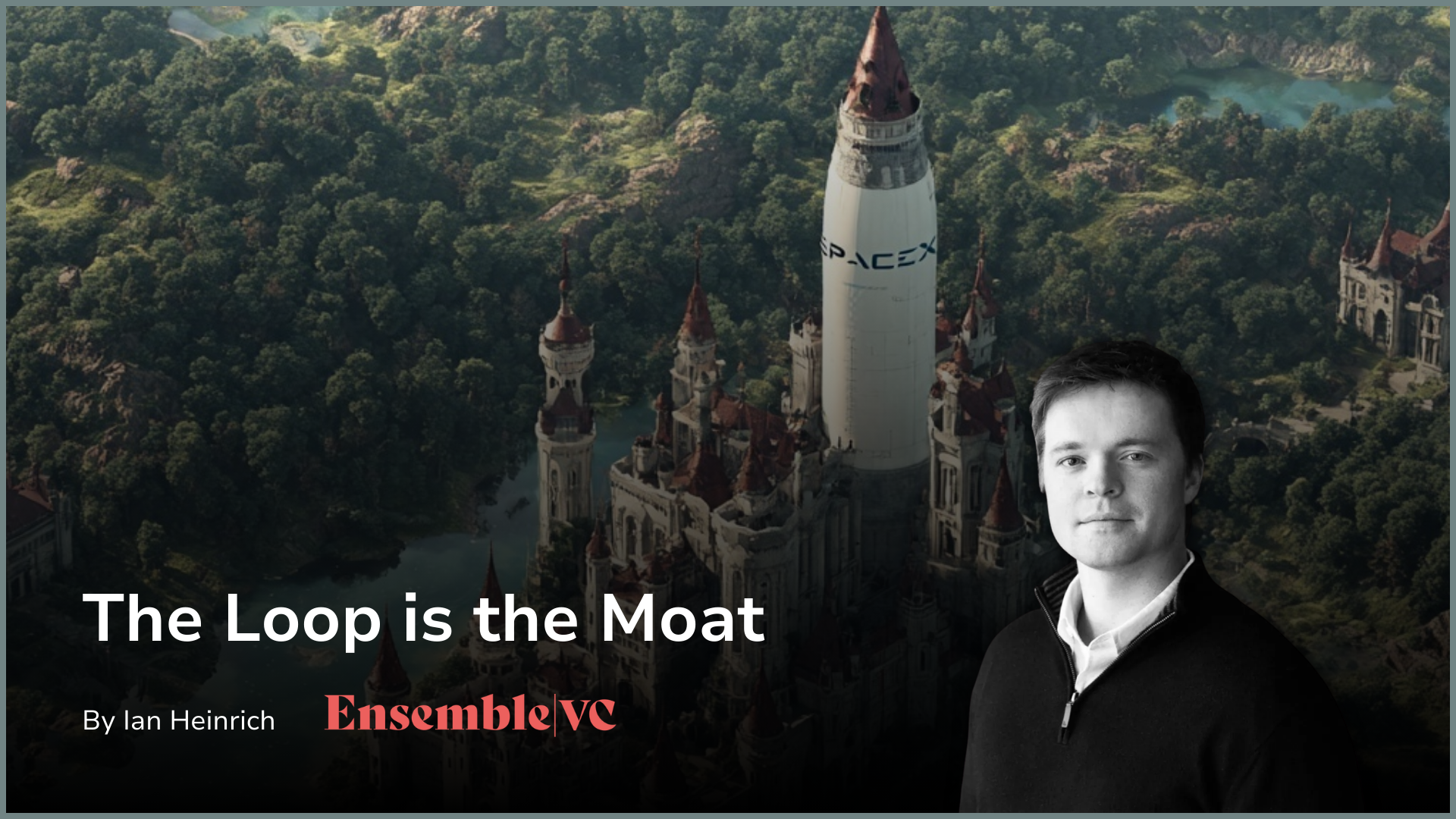
If we can't build thousands of autonomous surface vessels, we shouldn't build any at all. - Dino Mavrookas, Founder/CEO, Saronic
Ensemble was founded nearly a decade ago on two main beliefs:
- proprietary data will reshape the most important companies of the future, and
- America's physical economy needs to be reinvented.
These ideas might seem separate. We've come to see them as one.
The idea of reindustrialization, reshoring, defense, energy, housing, has shifted from an outlier view to something close to consensus. We share in the excitement. But the more time we spend with founders building in the physical world, the more clearly we see what separates the companies that will matter from the ones that won’t.
The companies that will define the future of the physical world treat every build as a chance to generate data, feeding what they learn back into the next unit, improving efficiency and cutting costs with each iteration. The only path onto the compounding curve is through disciplined repetition (see Wright’s Law). The real asset isn't just the thing they built, it’s the system that builds it, and the data that system generates over time.
Useful data means less variance. The winners reduce degrees of freedom until cause and effect becomes clear; then they scale. Every decision that makes the process more controllable makes the learning faster and the moat deeper.
There are two kinds of AI. Only one builds a moat.
There are two things a physical company wants AI to do, and they have opposite data requirements.
Operational AI (quality control, predictive maintenance, anomaly detection) can run on imperfect data. These tools are real and valuable, and increasingly becoming commoditized. Any company can buy them.
What can't be bought is systems AI: the model that learns how to build the thing better, predicts how design changes will affect production outcomes, and eventually drives toward autonomy. That model requires comparable observations of the same underlying process, repeated enough times to have genuine predictive power. AI can find patterns in chaos. It cannot predict the future of a process that has no consistent past.
The best founders we've seen aren't just thinking about how to use AI on their production data. They're designing their production process as a data generation strategy from day one. The loop isn't a prerequisite for AI. It's what makes your AI impossible for anyone else to replicate.
What this looks like in practice
Founders who get this entirely flip the conventional sequence. Instead of the canonical advice of prototype, find product-market fit, then figure out manufacturing, they let manufacturing requirements shape the product from inception.
One of the best examples from our portfolio is Saronic. Saronic's head of manufacturing, recruited from SpaceX, was their third employee, hired before they had a prototype. The result: 80% hardware consistency across platforms, seven core modular components, a fully vertically integrated supply chain. As Saronic’s founder Dino Mavrookas puts it, "If we can't build thousands of autonomous surface vessels, we shouldn't build any at all."
In construction, ICON built their manufacturing system - the Vulcan printer, the Magma mixing unit, the BuildOS software - before they had commercial scale. Every house instruments the process, not just delivers a unit. The result is meaningful cost reduction with every doubling of cumulative production. The home was never the product. The system that prints it is.
What we’ve seen work is to figure out which 80% of your build is predictable and design systems that absorb the other 20% without breaking the loop. Customers want custom, regulations vary, site conditions differ. Instead of ignoring that variance, design around it so the exception never breaks the system. Every custom engagement is a tax on the loop. So, price bespoke work accordingly, and importantly, decide before the customer is in the room which deals you'll walk away from.
The project trap
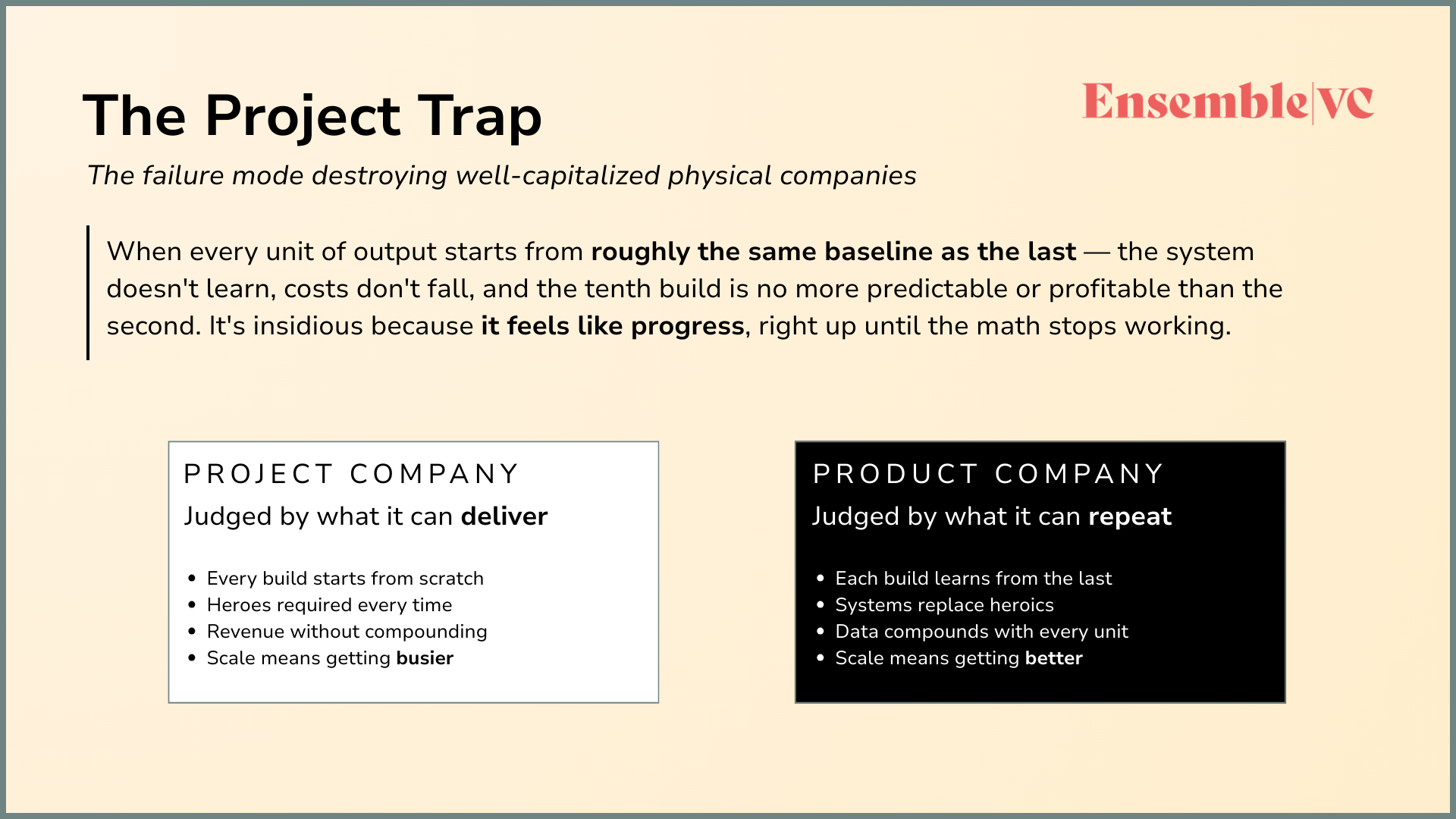
Most companies never get there. Not because of the vision or the market, but because they fall into what we call the project trap: each output begins from a similar baseline as the last. The system fails to learn and costs don't decrease. The tenth build is just as unpredictable and unprofitable as the second.
The trap is insidious because it feels like progress. Custom projects bring in revenue, please investors, and attract attention. Katerra raised nearly $3 billion on the right pitch: factory-built components, vertical integration, costs driven down through scale––and still fell into the trap. They said yes to everything. The factory never repeated the same thing twice and thus never learned. Six years later they filed for Chapter 11.
Fisker, Proterra, Solyndra: different industries, same ending.
The incentives that sustain the trap feel reasonable at every step. That's what makes it hard to escape from inside it.
A simple test
When demand doubles, does the company get better or just get busier?
Projects get busier. Products get better.
The founders who escape the trap do so from inception, before the prototype, before the first customer, before the first hire. They instrument what they can't yet interpret and walk away from revenue that breaks the loop. They understand that the data their system generates is the asset that eventually no one else can buy their way into.
We've built Ensemble the same way. A dedicated data science and engineering team has been part of our firm since inception, applying the same systems AI logic to venture that we look for in the companies we back. The loop isn't just a thesis. It's how we work.
Some of our most important relationships started with tinkerers and back of the napkin sketches. If you're still figuring out the shape of the thing but you're thinking about it the right way, that's enough to start a conversation. We invest from pre-incorporation through Series A and we're most useful earliest.
If any of this resonates, we want to meet you.
Dear VC Partner: Your Firm is Falling Critically Behind. And It's Probably Because of You
In this article, Dr. Gopinath Sundaramurthy argues that while venture capital firms are aggressively funding AI platforms, most have failed to adopt AI meaningfully within their own organizations. Drawing on Ensemble VC’s decade of experience building an AI-native investment platform, the paper explains why superficial AI usage—tools, pilots, and isolated workflows—does not translate into durable competitive advantage.
IPO Alert: Groww goes public!
Ensemble-backed Groww goes public on NSE-India at $8.9B valuation Groww, one of Ensemble VC’s earliest data-driven investments, completed a successful IPO on the NSE, marking a major milestone for India’s retail investing market. Backed at the Series A pre-revenue, Groww exemplifies Ensemble’s strategy in action — identifying world-class teams early through its proprietary Unity platform.
Collin West to headline AlphaCore Wealth Summit 2025 in La Jolla
We’re heading to La Jolla for the 2025 AlphaCore Wealth Advisory Summit!In one week, our team will be on the ground at the AlphaCore Wealth Summit, one of the industry’s most forward-looking gatherings for wealth managers, allocators, and innovators. This year’s theme — Back to the Future — sets the stage for a conversation about how artificial intelligence and emerging technologies are reshaping wealth creation and capital deployment. If you’ll be there, we’d love to connect in person.
Why Ensemble is Backing Stablecore’s Mission to Bring Community Banks into the Stablecoin Future
Ensemble is thrilled to announce our investment in Stablecore, the infrastructure platform enabling banks and credit unions to offer stablecoins, tokenized deposits, and other digital asset services.
Gopi's Manifesto
In this excerpt from Ensemble’s Mid-Year Investor Letter 2025, Gopi Sundaramurthy, Founder and Head of Data Science, outlines a new model for investment firms in the age of AI. As one of the preeminent data scientists in venture capital, Gopi’s perspective is informed by over a decade of building data models for investors.