by Conrad Shang
Co-Founder and Managing Partner, Ensemble VC
This piece is adapted from Conrad Shang’s presentation at the Ensemble VC 2026 Annual General Meeting. For a full overview of the event, see here.
To our partners and peers,
At our recent AGM, I began my section of the meeting with a simple observation: people don't generally think about infrastructure until it breaks.
In 2021, a single container ship ran aground in the Suez Canal. A single boat blocked $9–10 billion in goods per day, offering us a prime example of how deeply we depend on the global shipping channels that are generally considered more dependable than they actually are.
Three months ago, most people couldn't have pointed to the Strait of Hormuz on a map. But now we all know it well because we’ve seen how a mere 50-mile stretch can create a chokepoint that is driving up gas prices, disrupting global supply chains, and wreaking economic havoc. What we’re learning the hard way is that as we build more advanced technology on these existing systems, our exposure to chokepoints increases.
This is what infrastructure looks like from the outside in: you basically don’t see it until it’s failed.
The Real Backbone
Effectively, what we’re learning is that the global economy’s backbone is actually physical (as in, what powers chips, moves goods, and supplies the critical minerals behind electrification and AI). That’s becoming clearer because these systems – neglected of talent and capital for too long – are getting more fragile, becoming more concentrated, and are more frequently tested, not as theoretical stress scenarios, but by real actors looking for real leverage.
While the vulnerabilities are structural, they aren’t new. In fact, concentrated supply chains and constrained manufacturing have often been single points of failure at the infrastructure layer. What has changed is that those vulnerabilities are now actively exploited.
And that shift changes how we are thinking about where to invest.

AI is only as resilient as what’s beneath it
There are many real reasons to be excited about AI, and at Ensemble, we definitely are.
But we also spend a lot of time thinking about the fact that AI doesn’t exist in a vacuum.Chips require advanced manufacturing. That manufacturing needs energy, materials, and functioning global supply chains. Pull on any of those threads, and you find the same fragilities.
But there’s another side to this. AI is also becoming the best tool we have to shore up these systems by providing more resilience, more autonomy, and new ways of operating in the physical world.
So what we're actually seeing isn't two separate trends, but rather a loop: critical infrastructure enables AI, and AI makes critical infrastructure stronger. That relational loop is our central thesis.

Following the People
Once we saw this dynamic, our question was straightforward: how do you get there early, first even? Our answer has been to follow the talent.
We've built a detailed, data-driven picture of where the best technical people are going, not just at the company level, but individually. We do this by tracking career moves, hiring patterns, and the formation of founding teams.
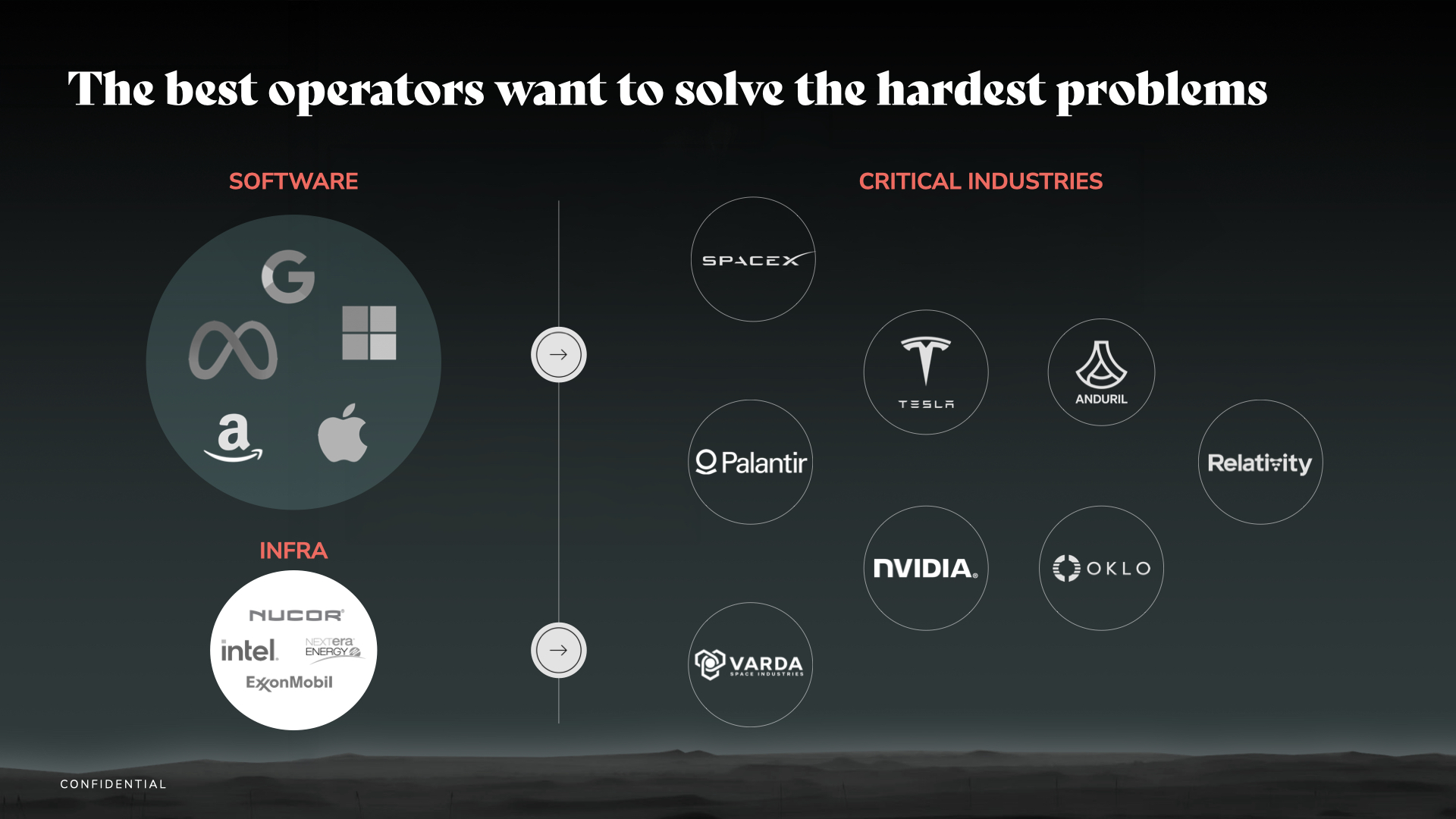
And we do this because talent flows are a leading indicator, often moving before markets do. A decade ago, the signal was top engineers leaving traditional software companies to build Tesla, SpaceX, Palantir, and Anduril. We're tracking the next wave of now.
That’s how we found ICON in 2019, Saronic in 2023, CHAOS in 2024 — well before these themes had broad market recognition. The pattern was legible in the talent data first.
The most important shifts in technology show up in talent flows before they show up in markets.
What we’re watching next
Over the next five years, the clearest signal is a broad shift toward building in the physical world. A new generation of founders is emerging, focused less on software abstractions and instead on rebuilding and scaling physical infrastructure, faster than any previous generation could.
The technological enabler is AI, which is now incorporated into physical manufacturing processes from the very start. Physical products now iterate like software. Digital twins compress timelines. And feedback loops that used to take years now take weeks.
We're also watching the line between defense and commercial continue to blur. Dual-use is becoming the dominant logic across much of the venture ecosystem. Commercial innovation feeds defense capability, and defense requirements accelerate commercial progress. These worlds were never actually separate, but now the convergence is out in the open and accelerating.
Across energy, defense, manufacturing, and logistics, data is moving seamlessly across domains in ways that weren't possible five years ago. The physical world is beginning to behave more like the digital world — and the companies being built at that intersection are, in our view, among the most important investments available right now.
All the best,
Conrad Shang
Managing Partner
For more information on Ensemble’s AGM and investment partnerships, reply to this message or reach out directly to carolinetrant@ensemble.vc
Neion Bio: Turning Farms into Medicine Factories
Learn how Neion Bio genetically engineers chickens to produce therapeutic proteins in their eggs, turning farms into biologics factories that run on grain and water.
WSJ: Saronic Corsair locates and rescues downed U.S. pilots
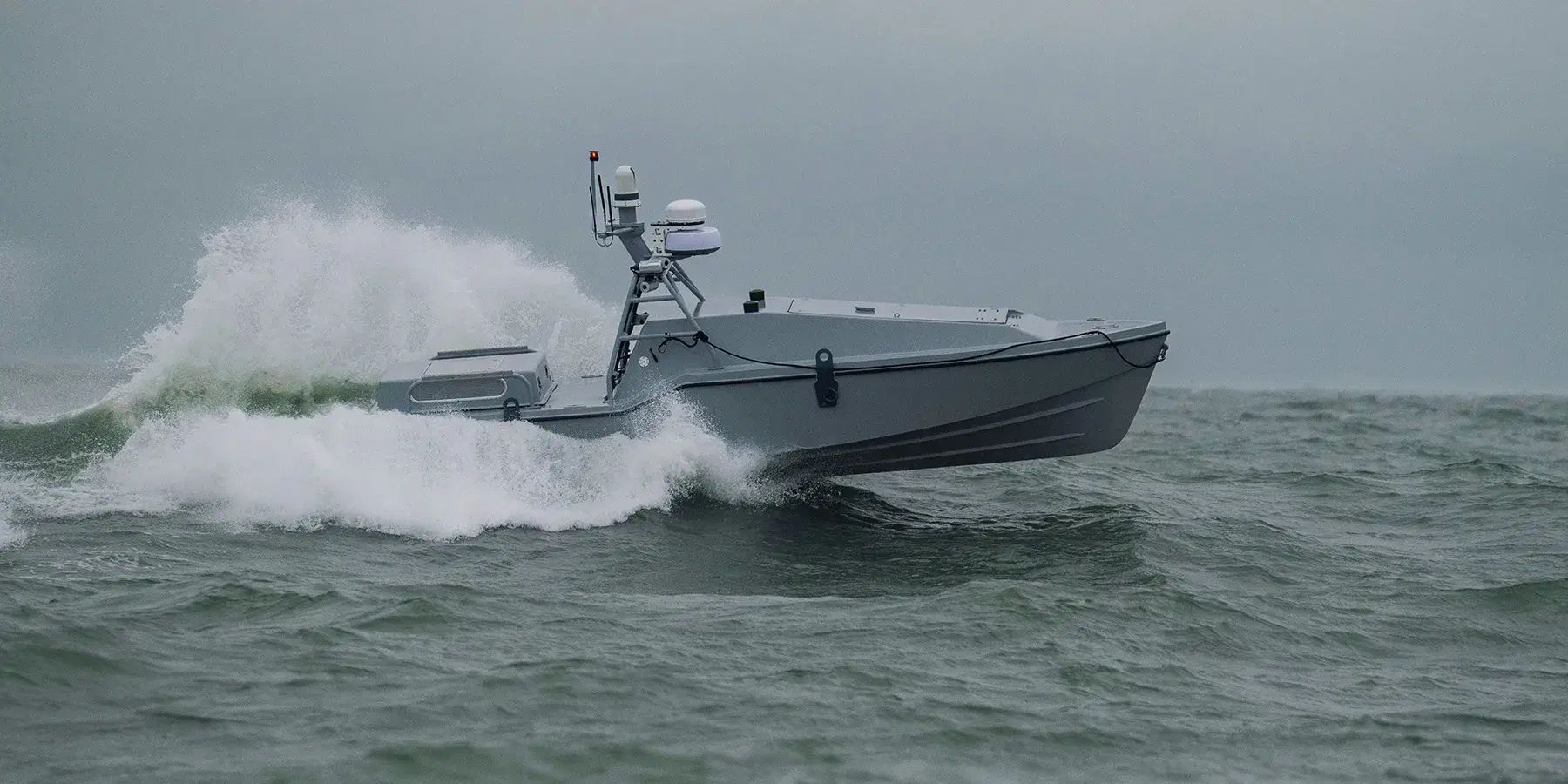
The Journal reports the crew had spent two hours in the water off the coast of Oman. An unmanned vessel (Saronic Corsair) found them and brought them to shore safely.
Q2 Update: Ensemble VC’s AGM features world-leading founders, Ensemble data breakthroughs
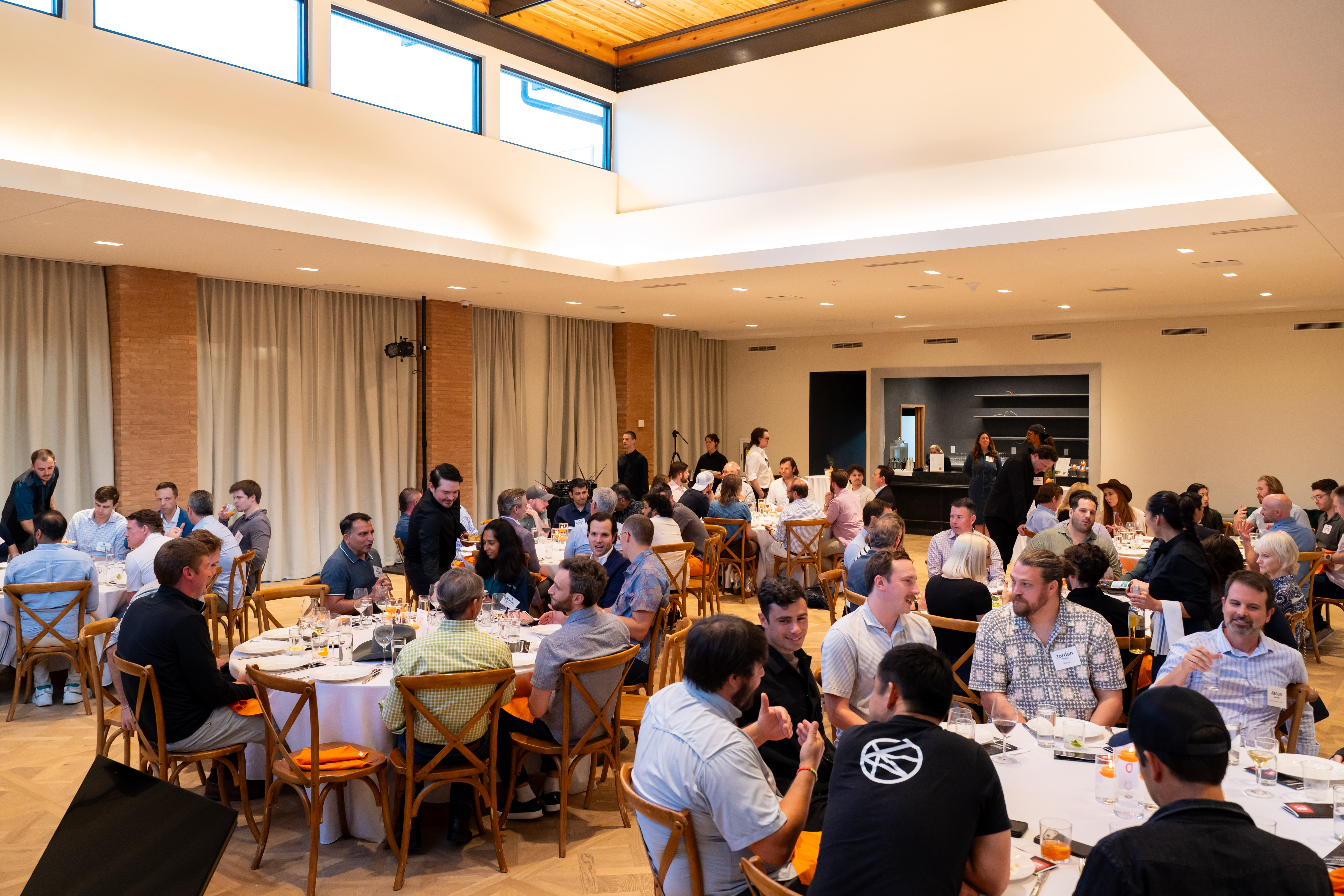
Ensemble's 2026 AGM brought together founders, LPs, and investors for a deep dive into the interplay between AI and the critical infrastructure it's built on.
Systems That Learn: What We Look For in Physical AI Companies
Physical AI and the Reindustrialization Window: What Separates the Companies That Will Matter From Those That Won't
Dear VC Partner: Your Firm is Falling Critically Behind. And It's Probably Because of You
In this article, Dr. Gopinath Sundaramurthy argues that while venture capital firms are aggressively funding AI platforms, most have failed to adopt AI meaningfully within their own organizations. Drawing on Ensemble VC’s decade of experience building an AI-native investment platform, the paper explains why superficial AI usage—tools, pilots, and isolated workflows—does not translate into durable competitive advantage.