by Collin West
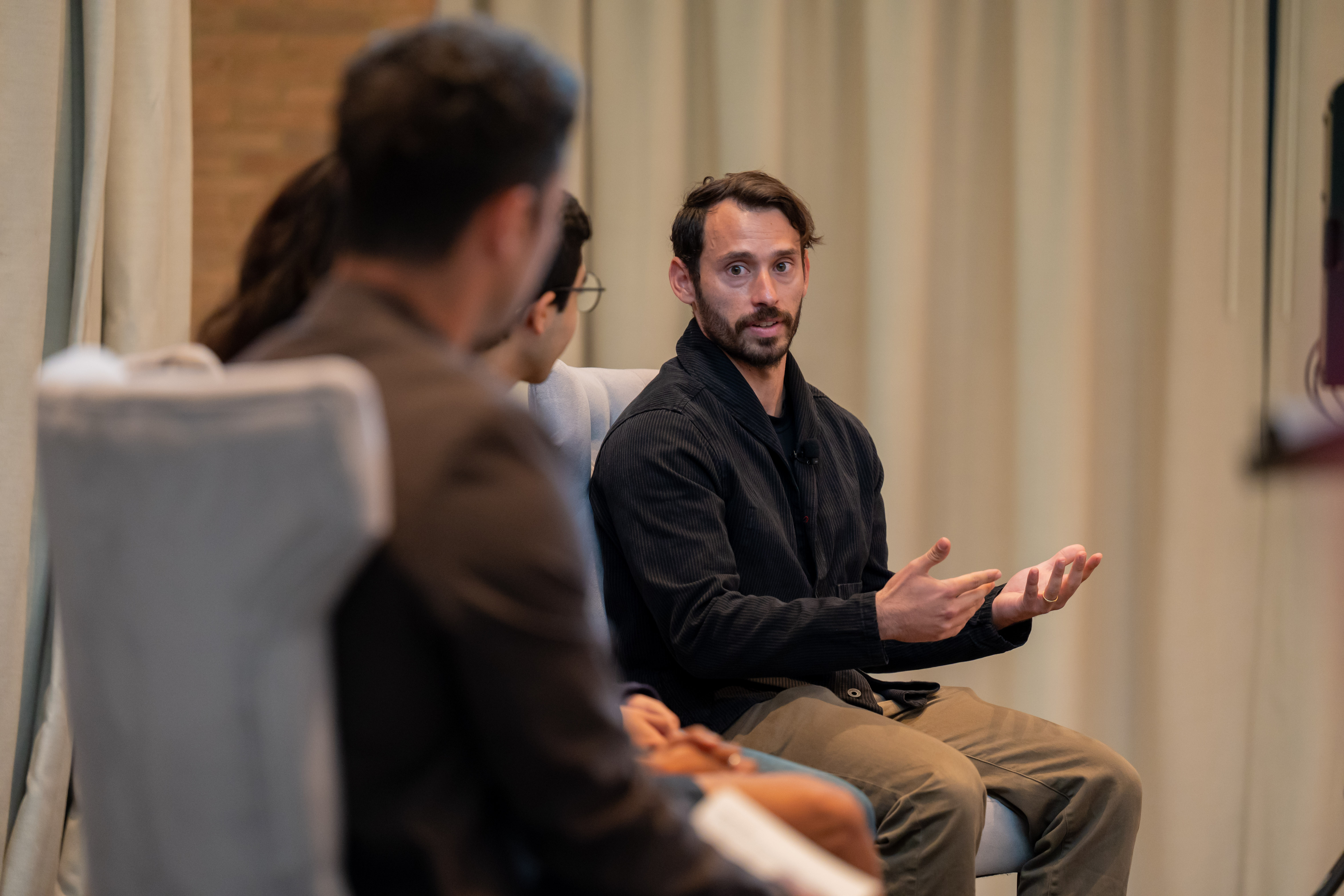
Recently we sat down with Dimi Kellari, CEO of Neion Bio. Neion doubles down on our thesis that at Ensemble we back the best founders building category-defining products in emerging fields that result in measurable change.
When we first met the team, we were struck by how direct the pitch and opportunity were: genetically engineer chickens so that their eggs contain therapeutic proteins, then manufacture medicine the way we already manufacture eggs at scale. As we've continued to learn more about the team and the mission, our enthusiasm has only grown, and we’re excited to share more here.
NEION SAW A PROBLEM WITH HOW BIOLOGICS GET MADE
Most expensive medicines today, which comprise the proteins behind treatments for rare diseases, autoimmune conditions, and cancer, are produced in bioreactors that use a single biological system — the Chinese Hamster Ovary cell (or CHO). It's a manufacturing approach that's been in place for over half a century, and it's expensive, slow to scale, and reliant on a small number of specialized facilities, mostly overseas. Nearly every attempt to fix this has been an attempt to build better bioreactors, but these still result in single-use systems, continuous processing, higher-titer cell lines, and intensified yields. This represented real progress, but all working within the same premise: that a stainless-steel facility is where biologics come from.
Neion Bio’s view is that there's a better tool for the job, and that biology already solved this problem better than we have. Chickens are, in Dimi's words, the best protein factory in the known universe. Take that as a starting point, engineer the right edits into a chicken's genome, and the egg itself becomes the production line. Scaling this operation means breeding more birds, not building another bioreactor facility, and the inputs required are simple and plentiful: just grain and water.
The implication for cost reduction is significant. Biologics that run tens or hundreds of thousands of dollars per course of treatment could, in principle, be produced at something closer to egg-production economics. The impact on supply chains is just as significant, creating a manufacturing process that can run on almost any farm rather than depend on a handful of facilities in a handful of countries.
THIS IS GROUNDBREAKING, BUT NOT NOVEL
The instinct might be to assume this is far-future biotech, but it's not. Chicken eggs have been used to manufacture flu vaccines for a century, and if you've had a flu shot, there's a good chance it came from one. More directly, an enzyme drug for a rare disease produced this same way has already been through the FDA and approved. And, importantly, three of Neion Bio's advisors come from the team that got it there.
What Dimi and his team are unlocking is precision. Genome editing in birds is harder than in mammals, and it's only become commercially viable in the last several years, made possible through a combination of CRISPR-era editing tools, cheaper genome sequencing, and the bioinformatics to know exactly where to make an edit. Neion Bio is building on 25 years of prior work in this space, not starting from zero.
THE TEAM
Dimi's own background is in aerospace and mechanical engineering, not biology. He spent his early career at Google X working on moonshot technology, then founded a self-driving car company, with earlier stints in manufacturing-constrained environments like CERN and aircraft design. Time and again, whether you're designing a plane or producing a drug, he's seen manufacturing be the bottleneck on what's possible, and biology is finally catching up to the point where it can be engineered with the same rigor.
Dimi's co-founder, Sam Levin, is an evolutionary biologist whose graduate research focused on the origins of life, addressing the question of how the first genomes evolved. The company's scientific leadership also includes one of only a few people who have ever successfully engineered complex traits into live animals — not just cells — with prior work ranging from hypoallergenic cats to de-extinction research.
WHAT THE PLATFORM ACTUALLY IS
Neion Bio currently has multiple products in development. The first wave targets biosimilars, which are generic versions of biologic drugs coming off patent over the next decade. They started here because that's where the cost and manufacturing advantage is most immediately relevant. But the platform isn't limited to biosimilars, and in theory, any large-molecule medicine could run through the same system.
It is a huge opportunity, but Dimi is candid about where the limits are. Neon’s platform allows biotech and pharma companies to develop and produce their drugs far more efficiently, but there are still bottlenecks in clinical trials. There is — for now — no shortcut yet around the fact that biology in a living system is far too complex to replicate in silico. What Neion Bio is building is the manufacturing layer underneath that process, resulting in faster to produce candidates, and a quicker, cheaper path to scale once something works.
WHY WE’RE SO EXCITED
There's a version of this story that's about genetics, but the version we find most interesting is about supply chains. Dimi grew up in Zambia and what Neion Bio unlocks on a global scale is that a place like Zambia, that has never been able to manufacture its own biologics could, in theory, do so with the same infrastructure it already uses to farm. Medicine production that doesn't depend on a handful of bioreactor facilities — and that scales using inputs as basic as grain and water — is medicine production that's resilient by design.
Where farms have fed our grocery stores for generations, Neion Bio's bet is that they should supply our hospitals too.
_____________
If Dimi's story resonates with you, and you're building (or want to build) frontier technology, we want to chat.
WSJ: Saronic Corsair locates and rescues downed U.S. pilots
The Journal reports the crew had spent two hours in the water off the coast of Oman. An unmanned vessel (Saronic Corsair) found them and brought them to shore safely.
Critical Infrastructure is the Foundation of the New AI Economy
AI can only go as far as the underlying physical infrastructure allows.
Q2 Update: Ensemble VC’s AGM features world-leading founders, Ensemble data breakthroughs
Ensemble's 2026 AGM brought together founders, LPs, and investors for a deep dive into the interplay between AI and the critical infrastructure it's built on.
Systems That Learn: What We Look For in Physical AI Companies
Physical AI and the Reindustrialization Window: What Separates the Companies That Will Matter From Those That Won't
Dear VC Partner: Your Firm is Falling Critically Behind. And It's Probably Because of You
In this article, Dr. Gopinath Sundaramurthy argues that while venture capital firms are aggressively funding AI platforms, most have failed to adopt AI meaningfully within their own organizations. Drawing on Ensemble VC’s decade of experience building an AI-native investment platform, the paper explains why superficial AI usage—tools, pilots, and isolated workflows—does not translate into durable competitive advantage.